Commercial KEE Roofing Systems in Scottsdale, AZ
Home / Roof Systems / KEE Roofing
Assess Scottsdale commercial KEE roofing by verified roof exposure, exact membrane formulation, assembly, drainage and manufacturer requirements.
KEE is a modifier used in some polyvinyl chloride (PVC) roofing formulations. A KEE membrane is still part of a specific manufacturer’s system, with its own reinforcement, thickness, attachment, accessories and seam details. Commercial KEE roofing in Scottsdale should be evaluated against the roof’s actual exposure and approved design, not selected from the abbreviation alone.
When a building team is considering KEE because of kitchen exhaust, oils, fuels or process chemicals, we first identify what reaches the roof and where it lands. For a facility near Scottsdale Airport and Airpark, site access and roof history come from the building owner; the neighborhood does not establish chemical exposure or the right membrane.
Confirm the named membrane and its documented composition
In roofing literature, KEE refers to ketone ethylene ester. Johns Manville describes its PVC/KEE membrane as a heat-weldable PVC product using an Elvaloy KEE polymer modifier, while Versico describes its KEE HP membrane as a PVC membrane made with a specified high-performance resin modifier. For VersiFlex KEE HP, Versico lists a higher-molecular-weight modifier with product-specific weldability and cold-flexibility characteristics. These are product statements, not a single universal formulation shared by every roofing brand. Ask for the exact manufacturer, product, membrane thickness, reinforcement, color and current technical data before comparing bids.
The formulation may matter where the roof is exposed to grease, oils, fuel or other chemicals. Manufacturer literature for named products describes resistance to some listed substances, but actual service depends on the exposure, concentration, contact time, cleaning practices and full roof assembly. A product statement does not promise that a KEE membrane will resist every process chemical. When the substance is unknown or recurring, obtain a safety data sheet and have the product manufacturer review the exposure before specifying the system.
A KEE system does not eliminate the need to control roof contamination. Exhaust discharge, spills, rooftop equipment, drains and maintenance practices can all affect where material collects. We inspect visible deposits and trace how contaminants reach the roof detail. The facility team may need to adjust equipment or cleaning procedures as part of the project. If recurring contaminants continue to reach the membrane, replacing a roof without correcting that exposure can leave the next system exposed.
Compare PVC and KEE products as system choices
Different KEE products are not interchangeable. A membrane may be smooth-backed, fleece-backed or reinforced with a specific scrim; thickness and accessory compatibility also differ. Some manufacturers publish membranes with KEE formulations at more than one thickness, while others identify KEE HP as a distinct formulation. We use the technical data and system details for the exact product instead of describing all KEE roofs with one performance profile.
Compare a KEE product with conventional PVC roofing when a project has an identified exposure question. Compare it with TPO roofing when the main decision is between single-ply assemblies with different material families, accessories and use limits. The right comparison is the written project performance requirement and the product documentation, not a broad statement that one material is always better.
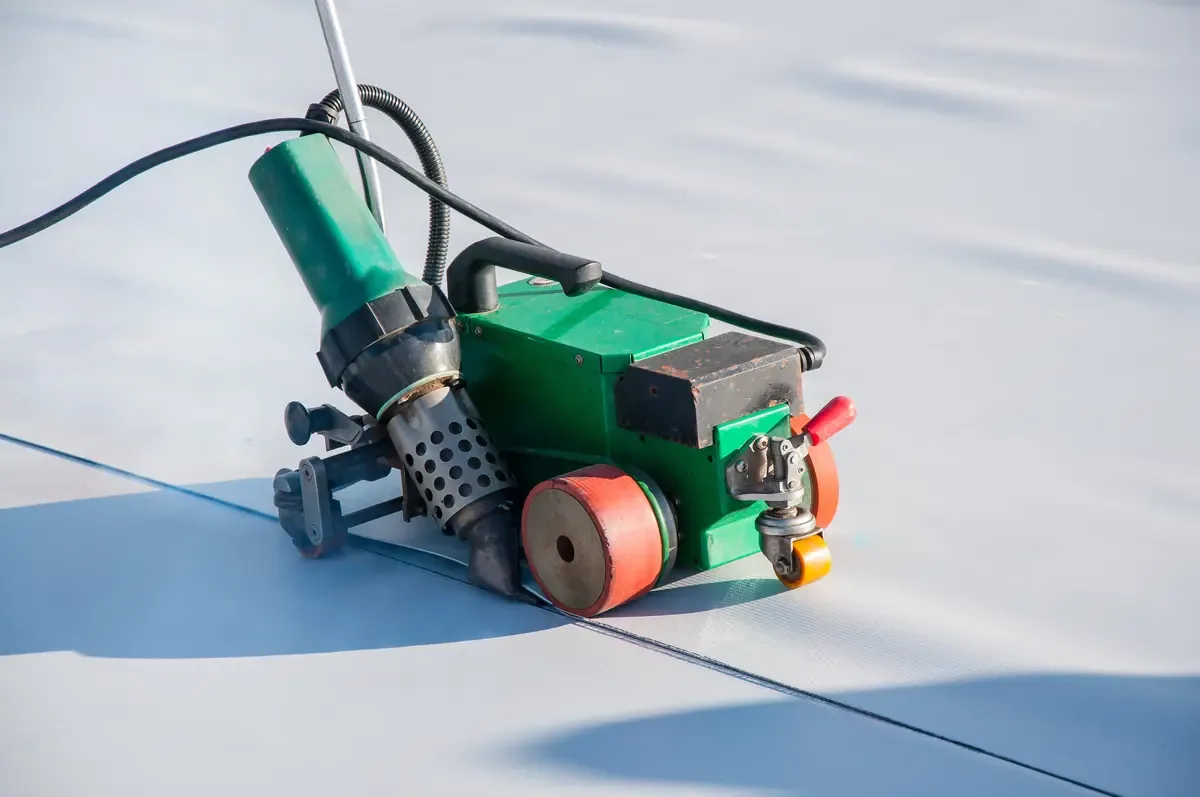
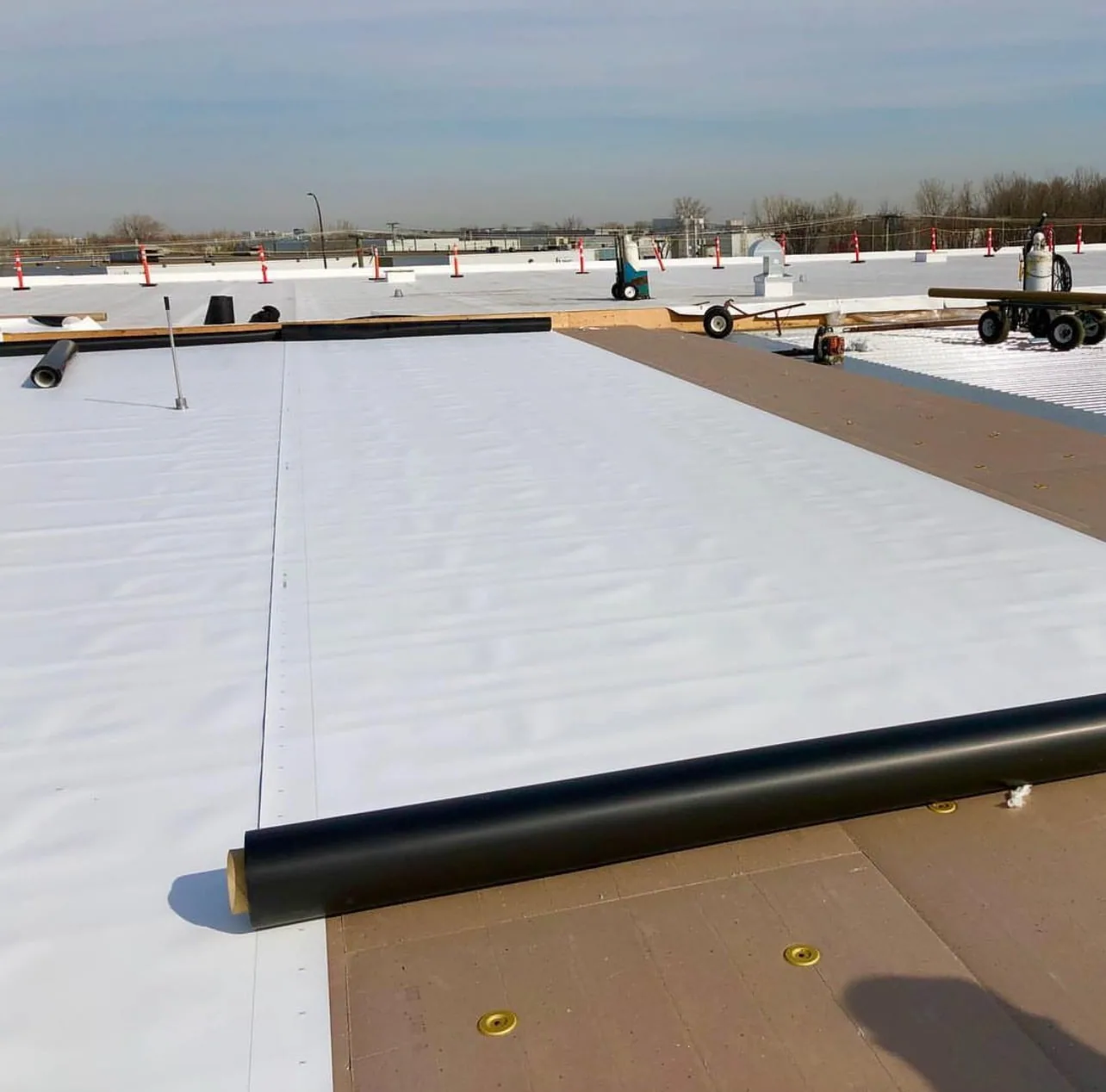
Seams are heat-welded on the product systems cited here, but welding settings, preparation, accessory use and quality checks follow the selected manufacturer’s details. At corners, curbs, penetrations and metal interfaces, accessory sheets may differ from the field membrane. Keep product data, approved details and installation requirements together in the submittal set so that the crew can verify each transition.
The term KEE does not settle how a membrane will perform at a grease exhaust, service walkway, or chemical exposure. Identify where contaminants may reach the roof, how often cleaning occurs, and which area must remain available for maintenance. Then compare the exact membrane documentation with the exposure and its stated limits. A product claim for one formulation does not transfer to every KEE sheet. At seams, use the specified welding temperature and procedure, then confirm that the test weld and production welds meet the manufacturer's instructions. Record any surface contamination or failed test before proceeding with a repair or new field sheet.
Design the whole roof, not only the exposed sheet
Deck type, existing layers, insulation, cover board and membrane attachment need to work as one assembly. An adhered, mechanically attached or induction-welded configuration may each be offered for a named product, but the approved assembly and project loads determine which may be used. The drawings should identify fastener patterns, perimeter treatment, wind design and fire classification. A sales data sheet does not take the place of project approval.
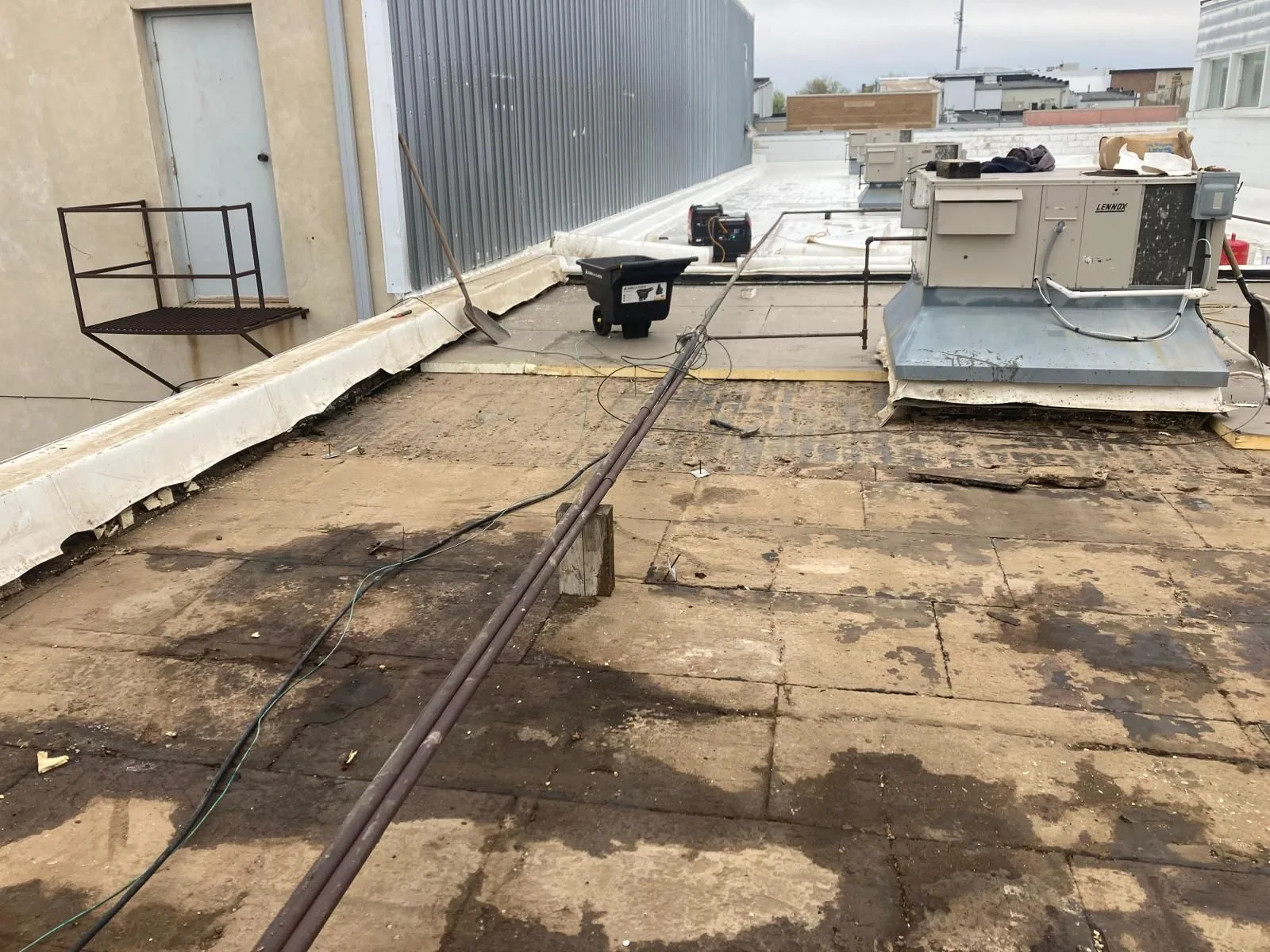
At re-roofing, survey the existing membrane, deck, insulation, drains, edges and curbs. Identify wet or deteriorated material, weak attachment, recurring leaks and areas where chemical exposure is visible. Insulation and cover-board work can change membrane height at drains and curbs, so coordinate the layers and transitions before ordering material.
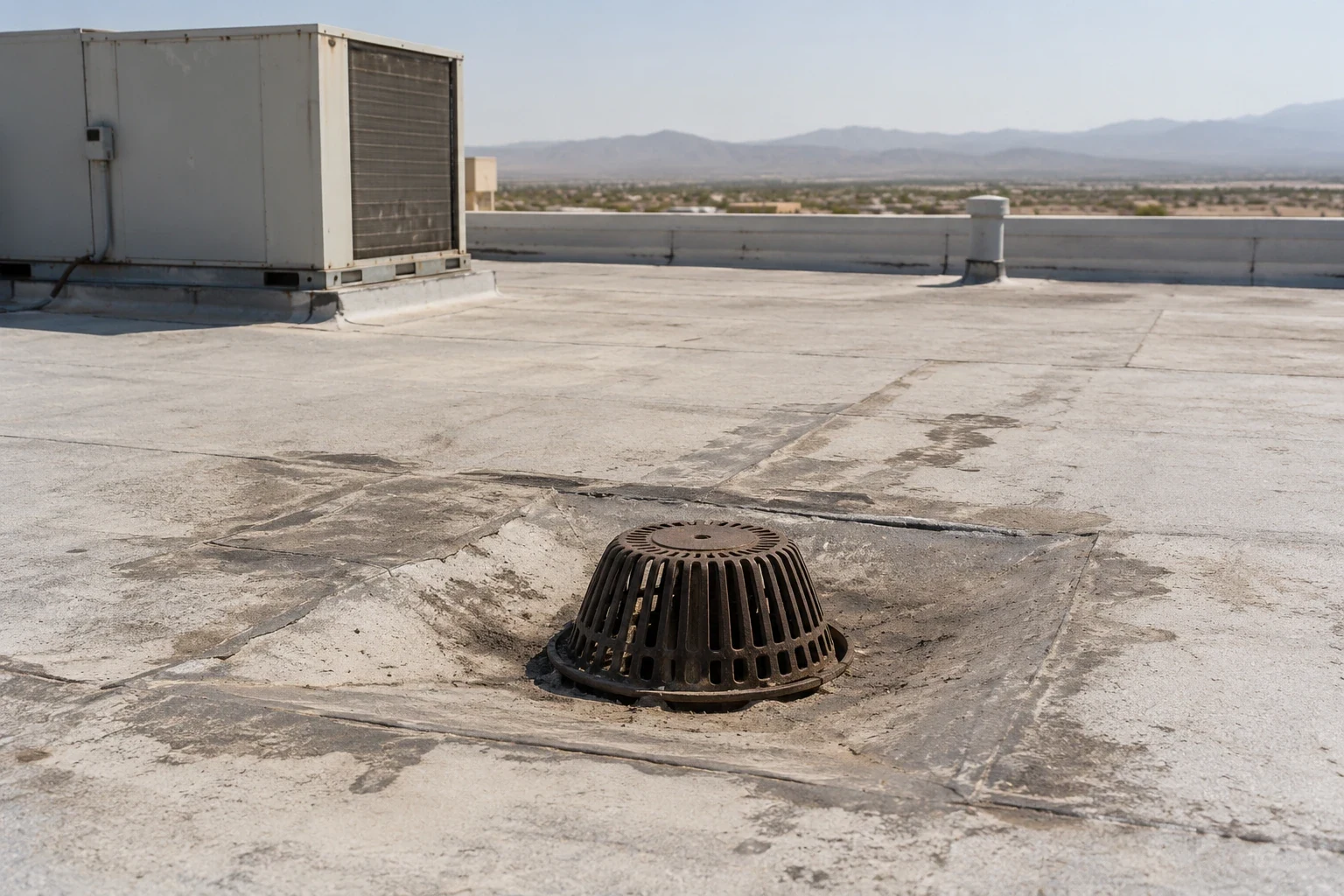
Drainage needs special attention where kitchen exhaust or process discharge is nearby. Keep the water path open and inspectable. If the drain bowl, clamping ring or surrounding membrane is damaged, drain and scupper repair may be a separate scope. The selected membrane cannot compensate for a blocked outlet or a poorly detailed roof transition.
Choose between repair, recover and replacement
A chemical-resistant product does not automatically make a roof suitable for recover. Existing moisture, attachment, incompatible layers, roof height, drainage, load and current code review still matter. If inspections or test openings identify wet or deteriorated layers, document their extent and decide whether they must be removed before new work is installed.
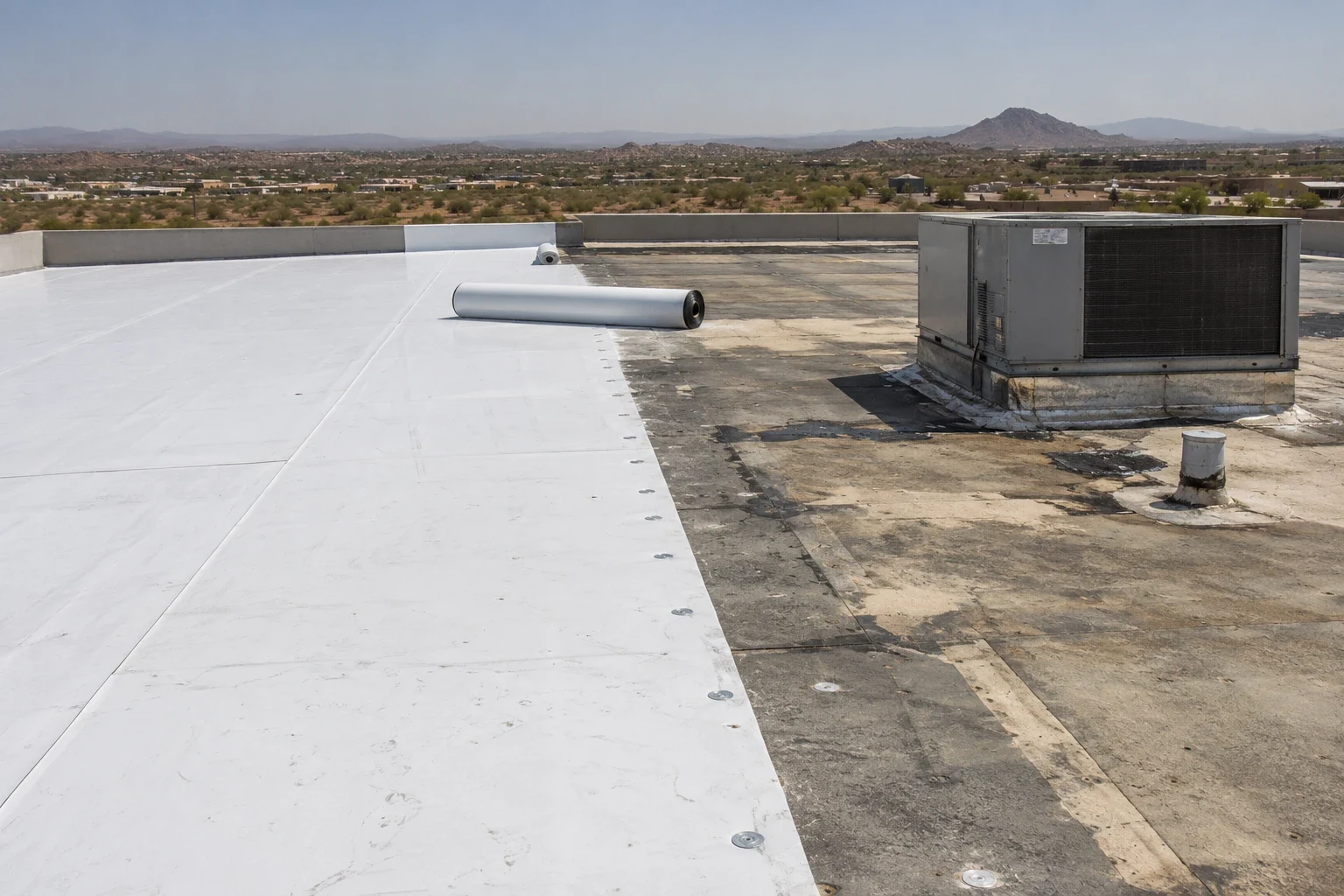
A recover may be possible when the roof condition and approved system support it. Review roof recover options alongside a replacement assessment when the existing assembly or exposure history is unclear. Where the roof remains in service, a commercial roof repair can address the verified area while the owner evaluates a broader project.
For restaurant facilities, route grease and exhaust concerns to the kitchen equipment and maintenance team as well as the roofing contractor. A PVC/KEE product may be worth considering when its manufacturer confirms compatibility with the documented exposure. Product selection alone does not modify the exhaust path or prevent housekeeping issues.
Build a KEE roofing proposal around evidence
We use the actual building plans, manufacturer data, roof inspection and exposure records to scope a KEE assembly. Our proposal can identify the membrane model and thickness, insulation, cover board, attachment, welded seams, detail accessories, drain work, exposure-control assumptions and closeout documentation. Unconfirmed chemical exposure or concealed roof conditions remain identified as open items for owner or design-team direction.
Share the Scottsdale address, roof plan, current membrane records, equipment and exhaust layout, material safety sheets if available, prior repair history and the project specification. We can inspect the roof and prepare a comparison of KEE and other membrane options grounded in the identified conditions. Preventive roof maintenance can document roof observations after installation under the owner’s maintenance plan.
Commercial Roofing Questions
What does KEE mean in roofing?
It is the roofing abbreviation for ketone ethylene ester. Some manufacturers use KEE resin modifiers in PVC membranes; the exact formulation and product properties depend on the manufacturer.
Will KEE roofing resist every chemical?
No. Match the exact substance and exposure conditions to the selected product’s technical documentation and obtain manufacturer review where needed.
Is KEE a type of PVC roofing?
Many KEE roof membranes are PVC formulations with KEE modifiers. Product descriptions and system details are manufacturer-specific.
Can KEE roofing go over an existing roof?
Sometimes, subject to the existing assembly, moisture, deck, attachment, drainage, load and manufacturer approval.
Evaluate a KEE Roofing Specification
Share the roof plan, named product, existing membrane records, equipment layout, exposure or safety data sheets and project specification. We can inspect the roof and identify the system and exposure questions to resolve before pricing.
Call or Email
Helpful to have ready:
The property address and a building contact
Where water or damage shows up inside
The roof type and age, if you know them
Photos and any past roof reports